Heritage Knit Shawl Dress
Student Name : Sofia Tsolaki
Mentor Name :
Company : CHIMAR


Green Producer Diary
My Motivation
I was inspired by a handmade knitted shawl that belonged to my great-grandmother and has been preserved for more than a century. I wanted to transform this heirloom into something contemporary while respecting its history, craftsmanship, and emotional value. Sustainability is important to me because it shows that what already exists can continue to live in new forms. Through circular design, the old can become new without losing its identity.
My Vetrine Journey
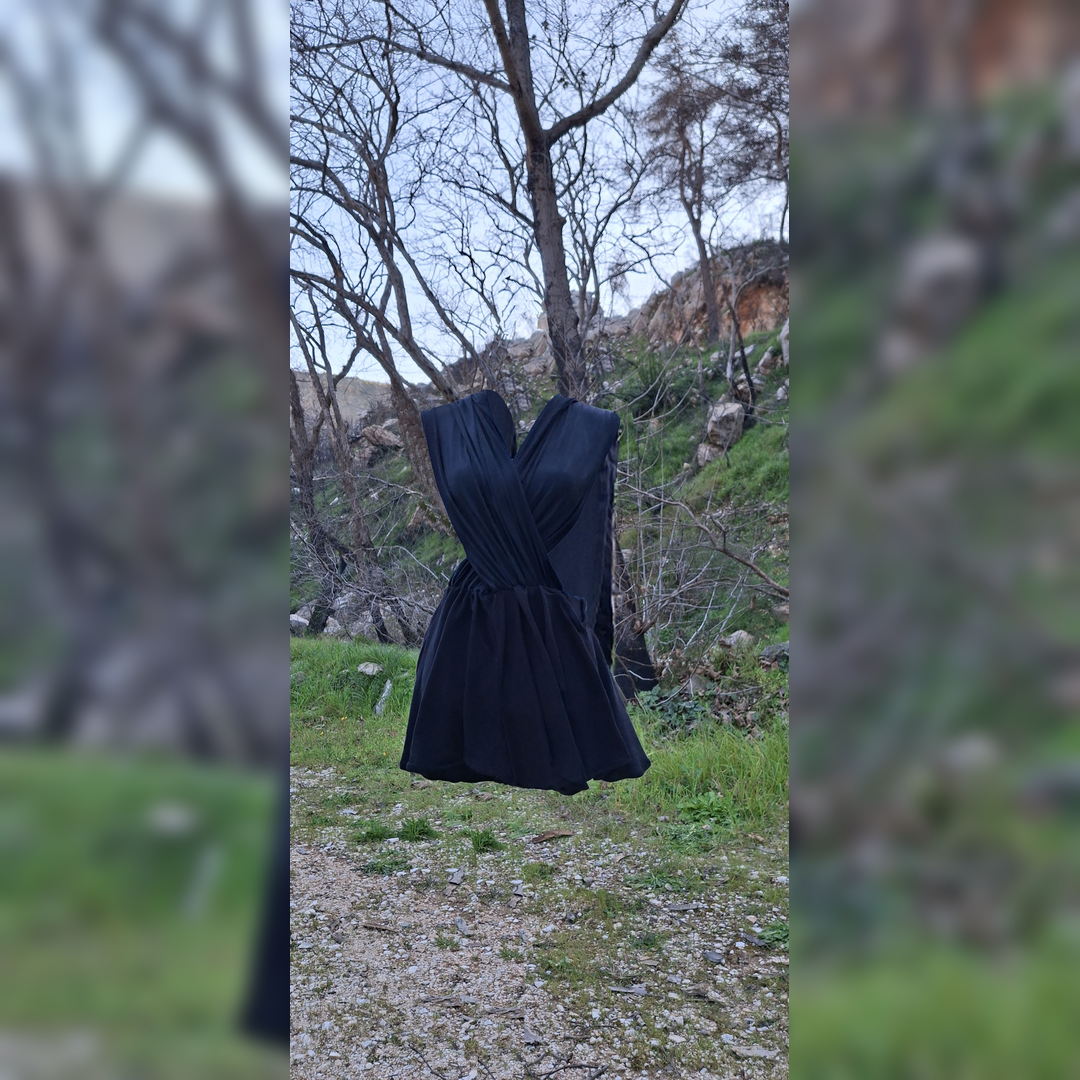
I began by studying the original shawl and thinking carefully about how to use it without damaging or altering its character. The piece was handmade from pure wool, naturally hand-dyed black, and built from four triangles joined into a large square with beautiful lace and tassel details. My first challenge was deciding how such an old textile could become a modern garment. I explored different design ideas before choosing to transform it into a dress that could feel elegant and wearable today. The most difficult part was solving the technical issues: where to place the seams, how to finish the edges, and how to stabilize the garment on the body while preserving the original handmade structure. I was careful not to distort the initial piece and added only a minimal elastic band for support. Step by step, I worked toward a final form that keeps the spirit of the original shawl while giving it a new purpose. The result is a contemporary dress created through respect, patience, and circular thinking.
Sustainability Aspect | Your Actions / Explanation |
|---|---|
Environmental | I reused a family heirloom handmade shawl that already existed, added almost no new material, and extended the life of a durable wool textile through circular design. |
Social | The project preserves intergenerational knowledge and traditional craftsmanship, while also being supported by mentoring connected to sustainability and circular economy values. |
Financial | The production cost remained very low because the main material already existed. By transforming a long-lasting textile into a new dress, the product gains fresh value without requiring new raw material investment. |
A Message to Consumers
I would like people to know that this dress carries memory, craftsmanship, and sustainability at the same time. It is not only a garment, but also a message that long-lasting handmade pieces deserve a second life instead of being forgotten.
A Message to Future Learners
Do not overlook old materials, because they may hold both beauty and potential. With creativity, care, and respect for what already exists, you can create something meaningful while reducing waste.
Product Details
Product Name
Heritage Knit Shawl Dress
Reference / SKU
VETRINE-SOFIATSOLAKI-DRESS-BLK-0001
Color
Black
Size
One size / adjustable
Weight
680 g
Quantity (if multi-pack)
One
Materials Information
Composition
Main material: 100% hand-knitted wool, hand-dyed black. Additional material: small elastic band for support.
% Recycled Materials
Materials: approx. 98% from the original shawl
Reusability: High – heirloom textile transformed for contemporary wear
Recyclability: Mainly recyclable/biodegradable natural wool once the elastic is removed
Traceable assets (materials origin IDs, fibers batches)
Original hand-knitted wool shawl (family heirloom, over 100 years old), composed of four joined triangles forming a square of approx. 1.40 m; original knitted lace border with handmade tassels; minimal elastic band added for bust stabilization.
Manufacturing & Supply Chain
1
Location
Greece
2
Date
3
Type of processes
Material preservation, concept development, draping, pattern adaptation, side seam construction, fitting, stabilization, finishing, preservation of original lace and tassels.
Concept development and transformation: Sofia Tsolaki
Original handmade shawl: family heirloom crafted by a previous generation
Mentoring support: Niki Chatzikyriakou
supply chain map
Tier 4Raw material
Tier 3Material processing
Tier 2Component manufacturing
Tier 1Final assembly
Environmental & Social Impact
Upcycled: Yes, Recyclable in part: Yes, Low-waste design: Yes, Low-cost prototype: Ye
Top-recyclable-40% Reusable (can be worn as a scarf or wrapped around the waist) Bottom-recyclable 85%
18 hours , 8€
Care, Repair & Lifetime Extension
1
Care Instructions
Hand wash cold or machine wash on gentle cycle, do not tumble dry, hang dry
2
Repair Information
Restitch seams or ties if needed. Reuse panels for future garments or recycle through textile collection where available.